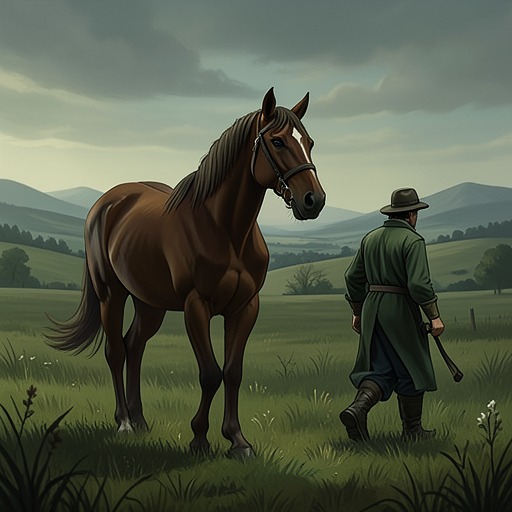
Never whip a horse for shying
Black BeautyNever whip a horse for shying is a humane training principle in Black Beauty: a frightened horse should be allowed to understand what has startled it, not punished in a way that compounds its fear. The rule emerges from a horse’s experience and is endorsed by Black Beauty, turning an ordinary roadside incident into a practical lesson about how people should respond to animals’ fear.
The Rule and Its Reasoning
The young horse explains that he had been timid from an early age. When something unfamiliar appeared, he would turn to look, but his master answered this behavior with a whipping. Because he wore Blinkers, he could not readily see or make sense of an object without turning his head. The horse reasons that calmly looking at strange things would have helped him learn that they posed no danger; punishment instead made him start more readily and did not reduce his fear.
The principle is therefore not simply a prohibition on one harsh response. It identifies a cause-and-effect pattern: fear prompts a start, punishment adds to the fear, and the horse becomes more—not less—likely to react. The proposed alternative is to let the animal examine unfamiliar sights and become accustomed to them. The account presents patient familiarization as a way to address the source of the response rather than suppressing its outward sign.
The Incident That Makes the Lesson Plain
The horse recalls a ride with his master and an old gentleman. A large piece of white paper or rag blew up beside him; he shied and started forward, and his master, following his usual practice, whipped him. The old gentleman objected and explained that a horse shies because it is frightened, and that whipping increases the fear and worsens the habit. His intervention gives the rule a specific setting: the horse’s reaction is not described as deliberate misbehavior, but as a response to something strange that he has not been allowed to understand.
The correction also changes what the horse believes about human treatment. Until then, he had assumed that all people punished a horse for shying. The old gentleman’s response shows him that some recognize the difference between wilfulness and fear, and that a familiar human practice can be challenged by a more informed one.
Black Beauty’s Endorsement
Black Beauty hears the account from the horse and explicitly recognizes its truth. He wishes that every young horse could have good masters like Farmer Grey and Squire Gordon. That comparison connects the rule to the book’s broader contrast between considerate handling and treatment that ignores what a horse experiences. Black Beauty’s agreement is grounded in the testimony he has just heard, not in an abstract instruction detached from the animal’s point of view.
The advice also sits in tension with the demands of breaking in described elsewhere in the narrative. A trained horse is expected to travel as directed and not start at what he sees, yet this episode shows why merely demanding a controlled response is not the same as helping a horse feel safe. The rule proposes understanding and patient exposure in place of punishment as a more humane way to meet that expectation.
Narrative and Ethical Significance
The lesson reaches the reader through animal testimony: the horse explains how Blinkers limited his view, what he did when something unfamiliar appeared, and how his master responded. That first-person account makes the animal’s fear and reasoning central to the episode, while Black Beauty’s confirmation links the advice to the narrator’s own values. The incident thus asks readers to interpret a start as possible evidence of fear rather than treating it automatically as defiance.
The book presents the rule as a practical moral maxim, not as a formal legal regulation. Its force comes from the contrast between two responses to the same behavior: punishment, which the horse says heightened his fear, and patient understanding, which the old gentleman recommends. By making the horse’s explanation intelligible, the narrative turns humane treatment into a matter of listening, learning, and changing how people act.